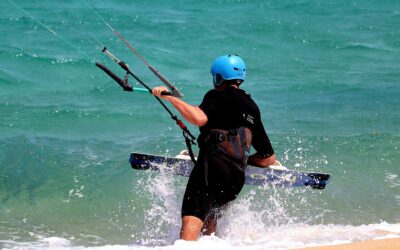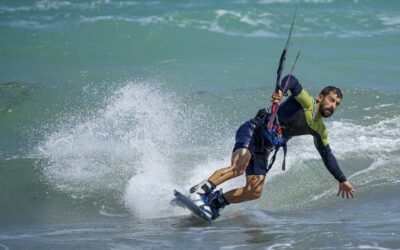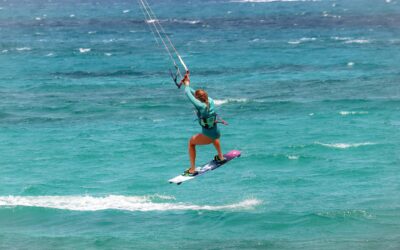
Have you ever watched a student attempt to kitesurfing waterstart and end up face-planting into the water like a pancake flipped by the mistral? In l’Almanarre bay, this sight is as common as a sudden gust of wind. Between two waves and just as many bursts of laughter, Greg and Colin—the two magicians behind KGG—repeat their mantra: “You prepare on the sand, you fight in the water, and it’s standing up on your board that you realize why nobody gave you a pink flamingo floatie!” Welcome to the world of kitesurf waterstart, where every session in the water feels like a circus act… just with more water up your nose.
Getting ready before takeoff: why everything begins even before you hit the water ?
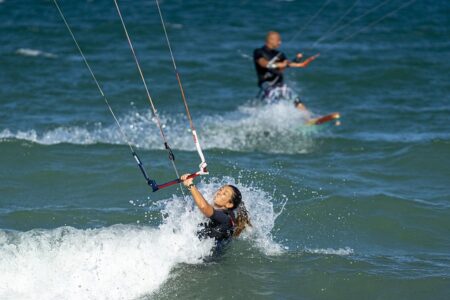
L’balance and preparation are the foundations of success. Getting familiar with the kite power, feeling the pull build in your arms, understanding how the current moves beneath your feet: these are essential learning milestones for succeeding in your first kitesurfing waterstart without ending up as a human donut. Those who take the time to position themselves correctly avoid looking like a floating pancake and manage to stay on their board for more than five seconds—which, let’s be honest, is sometimes nothing short of a local miracle.
Kitesurfing waterstart basics: position, kite, action!
What body position promotes a successful kitesurfing waterstart?
Do you think you’ll be popping out of the water like a motivated dolphin? Forget about it. It all starts with a body position controlled. Greg and Colin advise you to act like a spring ready to launch, without ever becoming that powerless piece of seaweed tossed around by the chop. Bend your knees slightly, keep your back straight (or at least try), and press the board against you. This way, your legs won’t start flying into freestyle mode at the very first ripple.
The secret lies in the coordinating kite and board. With arms extended forward to stabilize balance, the front leg guides while the back leg pushes. Imagine yourself as a Formula 1 driver, aquatic edition. As Greg puts it: “If you feel ridiculous, just watch Colin attempting a waterstart with a retro moonwalk… It’s reassuring, isn’t it?”
How to coordinate your kite and board to boost your waterstart?
The classic mistake: forcing the kite power without subtlety. The result: a Superman-style takeoff followed by a pancake-like landing. The trick is to introduce the power gradually, shifting your body weight to accompany the getting out of the water. Steer the kite toward 10 o’clock or 2 o’clock depending on your side, keep an eye on the wind window, and trigger the impulse at just the right moment. That is how you go from being a wet noodle to the rider impressing everyone at the spot.
For those looking to deepen their knowledge and make effective progress, we recommend referring to detailed resources on the basics of kitesurfing and gear setup, particularly to properly master footstraps before attempting your first waterstart. It is all about synchronization: going too fast only results in a massive splashdown. At KGG, Greg always advises staying “cool and calm” during that critical moment. Taking your time ensures you cover three meters of distance rather than swallowing three liters of water.
Essential techniques and tips to exit the water with style
What techniques and tips make the waterstart easier?
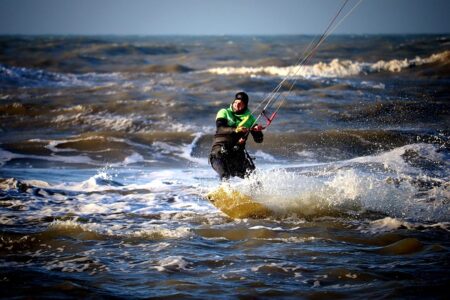
- Keep the kite in motion to ensure the the necessary pull at the start.
- It’s a workout for both your core and your mindset—anticipating the kite’s reactions is crucial.
- Looking far ahead: aiming for the horizon to maintain balance from the very first second.
Feeling the tension in the lines allows you to gauge the ideal power window. Nothing beats spending a few minutes practicing the movements on the sand, where failure only means a bit of grit stuck in your wetsuit—far less humiliating than a spectacular wipeout in front of the entire beach.
Which exercises can improve balance and conditioning?
For Greg and Colin, the perfect routine combines physical exercises and mental visualization. Mastering the’balancing on a BOSU ball, strengthening your legs with squats, or simulating exiting the water in the locker room (much to the amusement of nearby riders)—all of this prepares both body and mind. Here are a few drills suitable for everyone:
- Simulate a seated takeoff and then explode into an extension, while maintaining arm-leg coordination.
- Stringing together small controlled jumps, with an impulse on the back ankle.
- Working on torso rotation, which is essential for adapting to the ever-changing water conditions.
These rituals boost your ability to react instantly, especially when the wind decides to test your patience and nerves.
Common Mistakes and Pro Solutions for Real Progress
What are the most common mistakes during a kitesurfing waterstart?
One could write a best-seller about the fails of the kitesurfing waterstart. Greg gives a special mention to those who pull on the bar as if they were lifting a refrigerator. This is a bad habit: pulling too hard causes the kite to surge upward and lose all traction, guaranteed result: an express stall. Another error: letting the board drift, when it must remain centered and oriented in the right direction to avoid an involuntary turn.
Stress, rushing, forgetting your gear check, or overconfidence after watching three TikTok videos: the causes are many. Yet, a hundred humble and structured attempts are far better than a single success followed by ten wipeouts worthy of an end-of-year blooper reel.
What advice can be given to turn setbacks into tangible progress?
Humility, active listening, and repetition form the winning trio. At KGG, Greg and Colin encourage analyzing every attempt: Was the kite too high? Did I forget to apply pressure to my front leg?
- Lighten your grip: there’s no need to strain the bar; a gentle tension is all you need.
- Adopt a progressive exit trajectory: aim for a smooth angle and avoid emergency takeoffs.
- Watch the others: seeing Colin nail a waterstart moving in reverse—it is already a lesson in learning… or in gaining perspective.
With every session, each wipeout becomes an opportunity to improve, and every burst of laughter a salty yet formative memory.
Frequently Asked Questions about Kitesurfing Waterstarts at KGG
What are Greg and Colin’s tips for your first time in the water?

- Ensuring that the kite power meaning progressive, not abrupt.
- Look far ahead to anticipate what’s next, not at your curled toes.
The goal remains to take your time without rushing, and above all, to listen closely to the instructions provided at every learning stage.
How long does it typically take to master your first waterstarts?
Timing depends heavily on athletic background, physical fitness, and the number of supervised attempts made. Most students successfully complete their first upwind riding in:
| Level | Average number of sessions |
|---|---|
| Complete Beginner | 4-7 sessions |
| Seasoned athlete | 2-5 sessions |
With the effective method and a few personalized tips, progress can be surprising.
What are the essential accessories for a successful waterstart?
- A suitable board to his size
- A wetsuit comfortable and well-fitted
- Un lightweight helmet and a suitable harness
Never underestimate the importance of adjusting your harness and selecting the right kite configuration based on the day’s conditions.
What solutions can be offered to overcome repeated waterstart failures?
Patience and strategic analysis are essential. Greg and Colin often recommend:
- Review technique on land with an instructor to correct major flaws.
- Varying the drills of’balance and posture to increase stability.
- Alternate between short and long sets to improve the coordinating kite and board.
Requesting personalized feedback from a coach accelerates progress and minimizes frustration—it is the ultimate icing on the cake for any motivated rider!